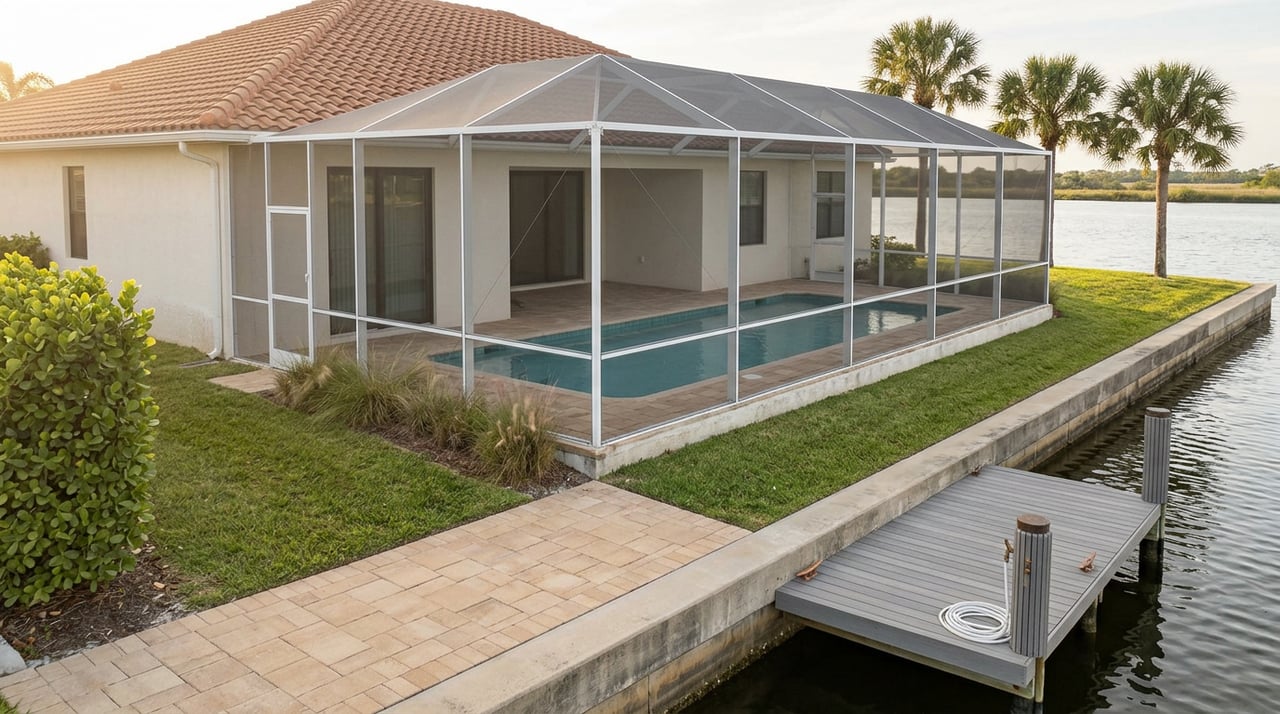
A buyer touring Sebastian this fall will see the word "waterfront" attached to homes that have almost nothing in common. A canal lot in Sebastian Highlands with a 40-foot dock. A direct river home on Indian River Drive with unobstructed lagoon views. A gated address inside Pelican Pointe with a slip at the community marina. All three get marketed the same way. All three carry a version of the same premium. And all three run into the identical hard limit the moment the boat actually tries to leave.
That limit isn't a canal, a seawall, or even the bridge two turns from the dock. It's the inlet.
Why "No Fixed Bridges" Doesn't Settle the Question
Sebastian's canal-front listings often lean on the phrase serious boaters look for: no fixed bridges between the dock and open water. It's a real and useful detail. A fixed bridge sets a permanent ceiling on how tall a boat can be, and unlike a shallow spot or an aging dock, nobody can dredge or rebuild their way past it. So the phrase earns its place in a listing.
What it doesn't tell you is what happens after the canal empties into the Indian River Lagoon. Every boat in Sebastian, regardless of which canal or river frontage it started from, eventually has to answer to the same chokepoint if it wants to reach the Atlantic: the Sebastian Inlet. And the inlet plays by different rules than the neighborhood canal system.
The Lagoon Sets the First Limit
Before a boat gets anywhere near the inlet, it has to cross the lagoon itself. The Indian River Lagoon, the body of water that Sebastian's canals and river frontage all drain into, runs shallow across most of its length, averaging somewhere between three and five feet deep. That depth supports kayaks, paddleboards, and small to mid-size recreational boats comfortably. It is far less forgiving for anything with real draft.
That single fact means the water in front of a Sebastian home, whether it's a narrow interior canal or wide open river frontage, is doing similar work in terms of what it can carry. A wider view doesn't automatically mean deeper water underneath it.
The One Door Out
Then there's the inlet itself. Sebastian Inlet is one of only five navigable channels along the entire Indian River Lagoon that connect it to the Atlantic Ocean. That scarcity alone makes it worth understanding before you buy anything marketed on its boating access.
The Sebastian Inlet District, the special taxing district chartered in 1919 to maintain that channel, describes it in its own navigation guidance as a fair-weather, local-knowledge inlet used largely by smaller recreational fishing boats, not a deep-water corridor built for yachts. A1A crosses the inlet on a fixed bridge with 39 feet of vertical clearance. That number is generous for most center consoles and sportfishers. It is a real constraint for a sailboat with a tall mast or a motor yacht with a tuna tower and outriggers stacked on top.
Put those two facts together and the picture changes. A canal home in Sebastian Highlands can genuinely have no fixed bridges between the dock and the river, and still never offer the kind of unrestricted ocean access that phrase implies in a market built around deep-draft yachts. The inlet, not the canal, is doing the real gatekeeping.
What the Three Water-Access Tiers Actually Deliver
Sebastian's waterfront inventory breaks down into three practical tiers, and the neighborhoods sorting into each one carry different implications for what a buyer's dollar is actually purchasing.
| Water Access Tier | Where You'll Find It | What the Water Offers | What Still Limits You |
|---|---|---|---|
| Interior canal | Sebastian Highlands, Collier Club | A private dock with direct access into the canal system feeding the South Prong of the St. Sebastian River | Canal depth at low tide, any interior bridges, then the inlet itself |
| Direct river or Intracoastal frontage | Harbor Point and homes along Indian River Drive | Immediate access to the open lagoon with no canal transit required | The lagoon's shallow average depth, and still the inlet for ocean egress |
| Gated boating community | Pelican Pointe | A private marina, boat ramp, and structured slips as part of the community | The same inlet, the same fixed bridge, the same fair-weather channel |
Notice what stays constant across all three rows. The inlet doesn't upgrade because a home costs more or sits inside a gate. A buyer paying for a marina slip at Pelican Pointe is still routing every trip to the ocean through the same 39-foot clearance and the same conditions-dependent channel as the owner of a modest canal home three miles up the South Prong.
The Market Isn't Pricing This For You
As of mid-July 2026, Sebastian carried 89 active waterfront listings with a median list price around $379,000, and homes in that category were sitting on the market for roughly 77 days before receiving an offer. A month earlier, waterfront inventory in the 32958 zip code showed a similar median near $385,000 with a slightly longer 88-day average.
Those numbers describe a category, not a capability. A canal-front cottage with a kayak launch and a riverfront estate with a 150-foot private dock both get filed under the same "waterfront" label and can land in the same price band and the same days-on-market range. The listing data isn't sorting for boat access. It's sorting for proximity to water.
That gap is exactly where buyers get surprised after closing. A boat that doesn't clear the route it was promised isn't a paperwork problem. It's a boat that sits at the dock.
What to Confirm Before You Write an Offer
If reaching open water by boat matters to how you'll actually use a Sebastian property, a few questions are worth settling before you get attached to a listing:
- What is the water depth at your specific dock at mean low tide, not just the canal's general depth?
- Are there any bridges, fixed or otherwise, between this dock and the Sebastian Inlet, beyond the one the listing mentions?
- What is your vessel's total air draft, counted from the waterline to the highest point, including antennas, towers, and outriggers?
- What condition is the seawall and dock in, and has either been permitted or repaired recently?
A local agent or a marine surveyor familiar with the South Prong and the river's approach to the inlet can usually answer the first three in a single conversation. The fourth belongs to your inspection period.
None of this makes Sebastian's waterfront market less attractive. Boating in the county runs year round, launch points like the Main Street Boat Ramp sit right in the middle of the Sebastian Waterfront District, and the lagoon itself remains one of the most biologically rich estuaries on the Atlantic coast. The point isn't that the water is a liability. It's that "waterfront" is a starting point for a conversation, not the answer to it.
Three Distinct Questions Buyers Ask
Does a "no fixed bridges" canal listing guarantee ocean access? It confirms there's no permanent height limit between the dock and the river the canal feeds into. It says nothing about the inlet itself, which every route to the Atlantic still has to cross.
Is the Sebastian Inlet the only way out to the ocean from Sebastian's canals? For practical purposes, yes. It's the nearest of only five channels linking the entire Indian River Lagoon to the Atlantic, which is part of why its 39-foot fixed bridge and fair-weather conditions matter so much to anyone shopping specifically for boat access.
Does paying more for a waterfront address buy better boat access? Not automatically. Price correlates with proximity to water and lot characteristics, not with vessel size capability. A gated marina community and a modest interior canal lot can face the identical inlet constraint.
If you're weighing a Sebastian waterfront purchase against what you actually plan to do on the water, that's a conversation worth having before you tour, not after you've made an offer. Joe Matuella works these Sebastian waterfront neighborhoods regularly and can walk through what a specific address, canal, or dock realistically supports before you get attached to a listing. Let's Connect and talk through what the water in front of your next home actually offers.